

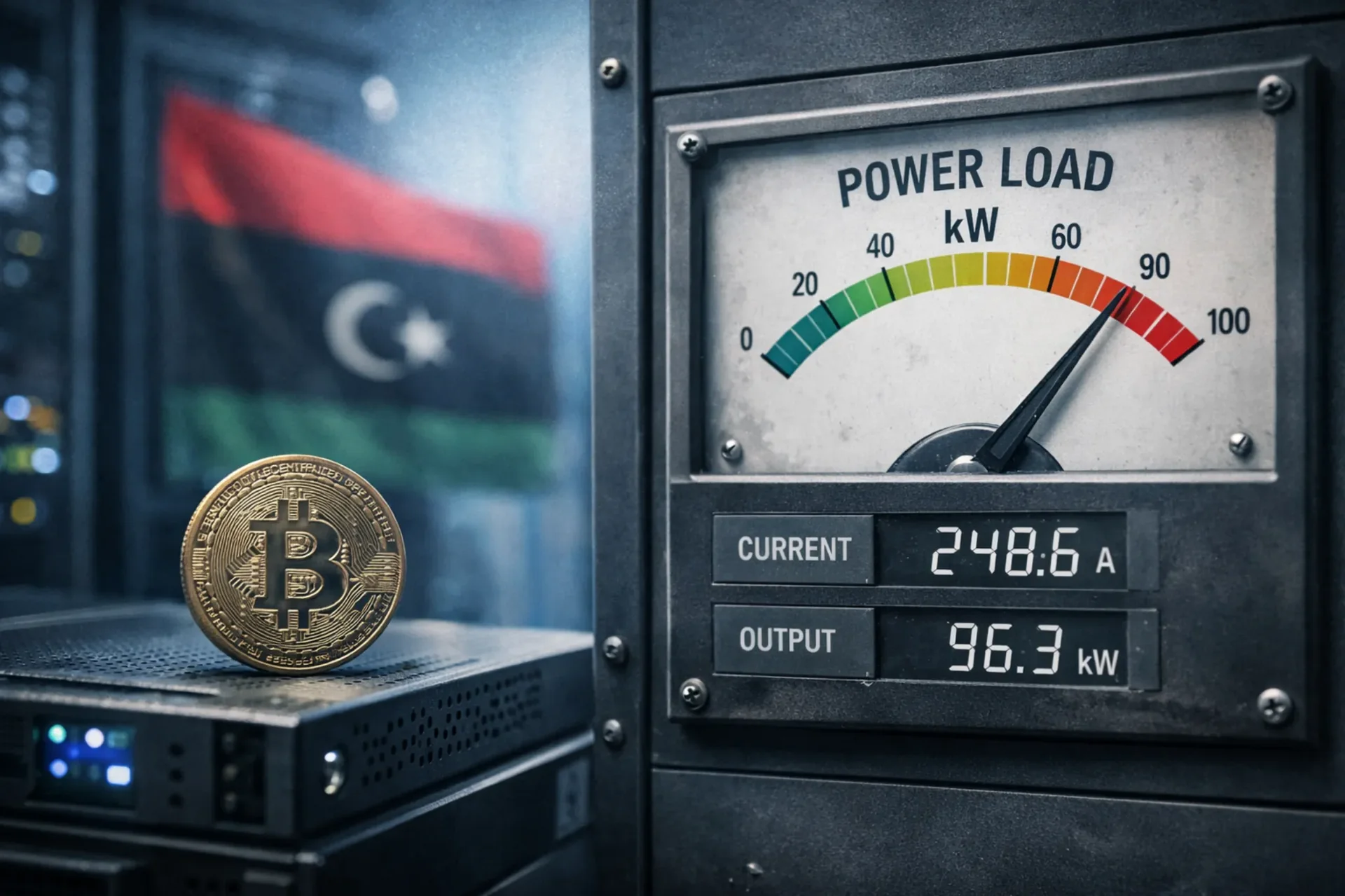
In late November 2025, Bitcoin and other cryptocurrencies moved into Libya’s public spotlight after local reports stated that the Tripoli Court of Appeal had sentenced nine individuals to three years in prison for operating cryptocurrency mining equipment inside the Iron and Steel Factory in Zliten. Not long before that, authorities had announced in 2023 the dismantling of a mining site in Misrata and the detention of 10 Chinese nationals on the same charge.
Bitcoin’s presence in Libya has therefore emerged in a highly controversial context, shaped by the heavy electricity consumption associated with mining operations, as well as the absence of a clear legal framework governing its use.
But before judging such incidents, it is important to first understand the asset itself: what is Bitcoin? How does it work? And why do cryptocurrencies attract so much attention around the world?
What is Bitcoin?
Bitcoin is a cryptographic digital asset designed to operate without a central bank or a single controlling authority. The core idea behind it is to enable users to transfer value directly from one person to another عبر the internet, without relying on a traditional intermediary such as a bank, which may impose high fees or create restrictions and complications that prevent transactions from being completed.
The cryptographic design of this digital asset allows all transaction data to be recorded in a sequential public ledger, with multiple parties holding copies of it to validate its contents. The original concept was introduced in the white paper published by Satoshi Nakamoto in 2008 under the title Bitcoin: A Peer-to-Peer Electronic Cash System.
On January 3, 2009, the first block of the network — known as the Genesis Block or block zero — was mined. It famously included the message:
“The Times 03/Jan/2009 Chancellor on brink of second bailout for banks”
This phrase, taken from a headline in The Times, is seen as more than just a timestamp. It is often interpreted as a signal of the crisis of confidence that shook the traditional financial system after the 2008 financial crisis.
How Does Bitcoin Work Without Complexity?
Blockchain: An Open Ledger… But Encrypted
Imagine a public ledger where every transaction is recorded. But instead of being stored in one place, many copies of it are distributed around the world to verify its accuracy. Groups of financial transactions are gathered into blocks, and each block is linked to the one before it, creating what is known as a blockchain. This is the backbone of the Bitcoin network, enabling verification and trust through near-total transparency.
Mining: Why Does Bitcoin Require Huge Amounts of Electricity?
Mining is the process in which specialized computers compete to solve a complex cryptographic problem. The machine that solves it first gets to add a new block to the chain and receives a reward in return, in addition to transaction-related compensation paid in Bitcoin.
This encryption-based mechanism and its reliance on solving difficult mathematical problems are among the pillars that make digital currencies difficult to manipulate. At the same time, however, they consume enormous amounts of energy. According to estimates by the U.S. Energy Information Administration, based on data from the Cambridge Centre for Alternative Finance, the global electricity consumption linked to Bitcoin mining in 2023 ranged between 67 and 240 terawatt-hours, with an average estimate of around 120 terawatt-hours.
That amount of electricity is enough to power millions of homes for an entire year. This explains why debates about Bitcoin mining are so often tied to the issue of energy.
Bitcoin Halving: How Does It Affect Bitcoin’s Price?
Bitcoin is not a currency that can be created out of nothing. It has a fixed maximum supply. To reach this cap gradually, the mining reward is cut in half roughly every four years.
For example, in April 2024, miners’ rewards declined from 6.25 to 3.125 Bitcoin per block. This means fewer new coins are entering the market than before. That is why the halving attracts so much attention from investors: a decline in new supply can reinforce scarcity, help shape the balance between supply and demand, and potentially support Bitcoin’s price over the long term.
Why Does Bitcoin Attract So Much Attention?
Bitcoin is seen by some as a hedge against the erosion of local currencies or against restrictions on financial transfers. For others, it is a highly volatile asset suited to speculation. A third group sees it as an entirely new financial infrastructure, built on decentralization, programmability, and trust in code rather than trust in institutions.
But that same attention is also what can make the market dangerously crowded. Bitcoin is not a savings account, not a guaranteed investment, and not a quick path to wealth. It is an extremely volatile asset, and regulators have repeatedly issued warnings about it.
In Europe, financial supervisory authorities have warned consumers that crypto-assets can be highly risky and speculative, that investors may lose all their money, and that there are also risks related to fraud, cyberattacks, and weak legal protections depending on the type of product and the service provider involved.
What Does This Mean for Libya?
1) Exploiting State Electricity Subsidies
The cost of electricity is a decisive factor in the profitability of mining, especially in environments where electricity is subsidized or not priced according to its real cost. In such cases, mining becomes highly attractive because a large portion of the operating cost is effectively borne by the state through electricity subsidies.
This is where the issue becomes bigger than a technical debate. It turns into a question of using a public resource to generate private returns. That is why cryptocurrency mining in Libya goes beyond technology and enters the territory of economics and sovereignty.
2) The Lack of a Clear Regulatory Framework Opens the Door to a Shadow Economy
When there is no clear regulation defining how an activity may operate, that activity often shifts into the shadows. At that point, unregistered transactions, hidden supply chains, and financial flows outside formal channels begin to emerge. The result is not an organized national debate over what is permitted, what is prohibited, what impact mining has on the electricity grid, and how anti-money laundering rules should apply. Instead, the landscape becomes chaotic.
This is the real strategic question: should the state simply fight the phenomenon, or should it establish a legal framework that defines it, measures its impact, and prevents it from becoming a burden on infrastructure? This is not a call to normalize disorder, but rather to recognize that the regulatory vacuum itself may be part of the problem.
3) Digital Assets Are Not Just “Trading”
Among the general public, the conversation may be reduced to buying and selling Bitcoin. But the reality is much broader than that. There is trading, yes — but also cross-border transfer channels, self-custody of private keys, centralized platforms, smart contracts, wallets, network fees, hacking risks, and the possibility of falling into fraudulent schemes.
So anyone entering this field without understanding the difference between these elements is not merely entering a market; they are entering an entire ecosystem of technical, financial, and legal risks.
4) Its Link to the Dollar and Liquidity
Part of the appeal of cryptocurrencies in fragile economies comes from the desire to access a global asset outside the local banking system. But that appeal can be deceptive. Moving from a crisis of confidence in the traditional financial system to a volatile and incompletely regulated asset does not always solve the problem. Sometimes it merely changes the type of risk — from domestic banking risks to cross-border price, technical, and regulatory risks.
For the Libyan Citizen: Understand Before You Risk
Before buying any digital asset, there are basic questions that should be asked:
What exactly am I buying? Is it really Bitcoin?
Where will I store it — on an exchange or in a private wallet?
Do I fully understand the severe volatility of these assets, and am I prepared to lose all my money?
Is the platform or provider I am dealing with actually trustworthy, or is it simply a good advertisement?
Read also: Investing for Beginners: What You Need to Know Before Entering the World of Investing. In this market, the mistake is not always choosing a declining asset. Sometimes it is choosing an unsafe platform, sending money to the wrong address, or falling for a project that promises “guaranteed” returns. The golden rule here is simple: the easier and faster the promises sound, the more caution — not excitement — is required.
Conclusion: Bitcoin in Libya Is a Story of Economics, Energy, and Governance
The story of Bitcoin in Libya did not begin on investors’ screens. It began in investigation files, raid reports, and court rulings. And that matters, because it reveals that, locally, this is not simply a debate about “financial innovation.” It is a debate about managing energy, controlling the informal economy, updating legislation, and building a system of financial oversight capable of understanding a digital world that moves faster than the laws meant to regulate it.
At Boursa, this is the core of the educational message: understand first. Where does the asset’s value come from? How does it work? What are the risks of holding it? And how can risk itself be identified?
Awareness is not a luxury. It is the first line of defense.
Reviewed and Edited by: Dr. Abdulmagid Bendalla

